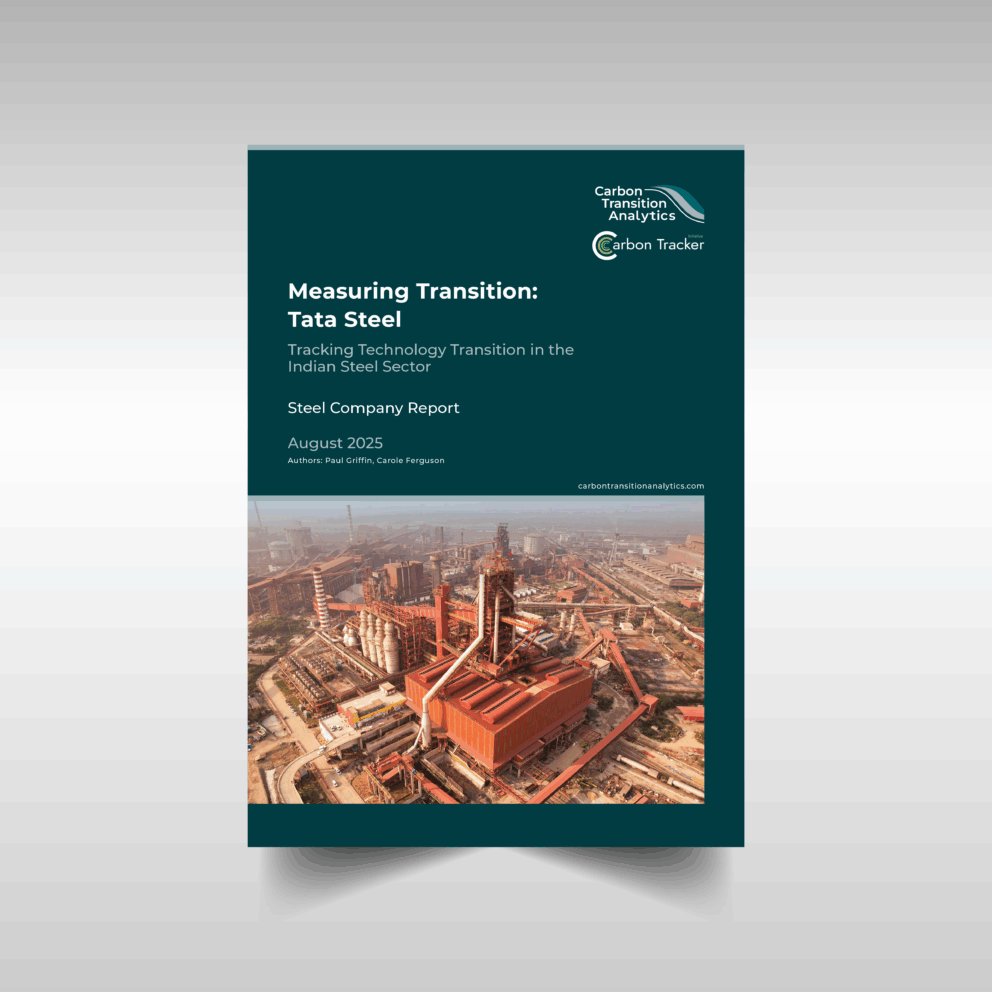
Tata Steel: Measuring Transition
Tracking Technology Transition in the Indian Steel Sector: A Steel Company Report
To attract transition and concessional financing, Indian steel companies will need to produce credible transition plans. This report is the second in a series of company-focused assessments on the transition performance of the Indian steel majors.
While steel production is vital for India’s development goals, limited access to raw materials, natural gas, and steel scrap makes it difficult to scale without deploying carbon-intensive technologies. This strategy poses a threat to company CO2 targets and could impact future profitability.
In this report, we analyse the state and outlook for Tata Steel in its strategy to grow steel capacity to 40 Mtpa in India by 2030 and transition to low-CO2 production in Europe.
Key insights from the report include:
- Tata Steel’s Indian and European CO2 targets perform well against policy and net zero – reaching net zero ahead of all other Indian steel companies and a European target aligning with EU policy and the IEA Net Zero Emissions Scenario.
- Disconnect between ambition and expansion plans in India – Tata Steel India would exceed target carbon budget if any additional blast furnaces are deployed, unless retired before their second campaigns.
- Improbable access to carbon storage sinks for CCS – With Tata Steel India’s production sites situated in the east far from potential geological carbon sinks.
- Future projects carry high risk of carbon lock-in – US$30bn of project capital has been confirmed or announced, with US$24bn for Indian projects. 74% of the Indian projects fall into the high-risk category.
- Transitional activities are focused on European operations – with TSN providing a clear and quantified transition plan while Tata Steel India provides only a qualitative list of initiatives. Tata Steel India could benefit from learning effects at TSN IJmuiden.
- Tata Steel India can stay within sight of its 2045 target and achieve 40 Mtpa – if they deploy 6 Mtpa of hydrogen-ready steelmaking via Direct Reduction-Electric Arc Furnace (DR-EAF) capacity by 2030/31. Cost reductions are possible with piped natural gas access and renewable remote captive power purchase agreements (PPAs).
- Tata Steel is less exposed to the upcoming CBAM regulation – European operations can sell to the EU market and only 2% of Indian production is exported to the EU. Growing Indian operations, however, face estimated export penalties of 40% in 2030 and 80% in 2034.